Government’s campaign for ‘Yes’ in referendum: Questions over impartiality and ‘mob’ fears

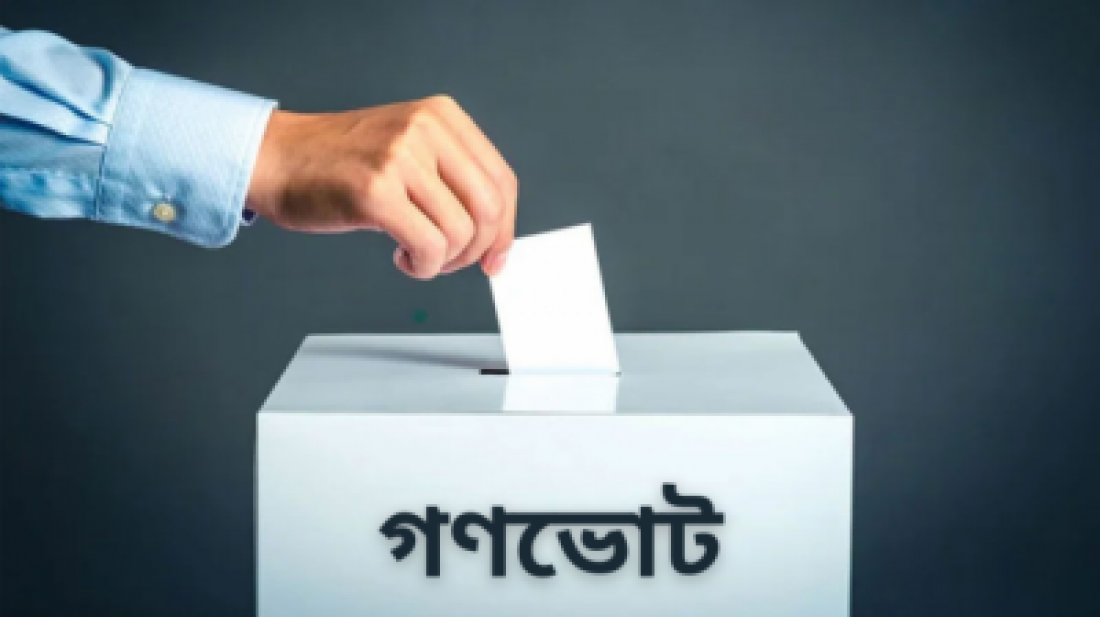 The public has raised many questions and concerns about the interim government’s public stance and extensive campaign in favor of a ‘yes’ vote in the upcoming referendum. Despite being a non-partisan government, all government offices in the capital, secretariat, district, upazila, union, and even village levels are spending money from the government treasury to encourage the general public to vote ‘yes’ in the referendum.
Not only that, office orders have been issued to support the ‘yes’ vote. Experts and concerned people have expressed concern about whether this is undermining the ‘neutrality’ of the government. On the other hand, many are being forced to join the government’s campaign for fear of being identified as ‘fascist allies’ if they take a stand in favor of a ‘no’ vote.
Meanwhile, Professor Muhammad Yunus, the chief advisor to the interim government, has called for a ‘yes’ vote in the referendum. He made the call in a televised video message to the nation on Monday (January 19).
According to sources from the Chief Advisor’s Office, Cabinet Division and Field Administration, all government departments from the Secretariat to the Union level have been instructed to campaign in favor of the ‘Yes’ vote. Chief Advisor Dr. Muhammad Yunus has given a status on his verified Facebook page explaining the reason for his stance in favor of the ‘Yes’ vote. In addition, the advisors are going to the district and divisional levels to exchange views with civil society and officials and directly asking for a ‘Yes’ vote. Advertisements in this regard are also being aired on government and private television channels.
Mob Fear and Obligation
It has been found that in various districts and upazilas of the country including the capital, government and private offices, banks and insurance companies, and even markets, banners and festoons of ‘Yes’ vote are being decorated. However, behind this, many people are afraid of ‘mob’ or mass beatings and vandalism. Top officials of several state-owned and private banks, on condition of anonymity, said that if they are against the government or take a neutral position, they may be labeled as ‘fascist allies’ and anarchic situations may arise. Basically, they are forced to campaign for the government to protect lives and property – even to avoid loss of life.
In this regard, M.A. Rouf, general manager of a private bank in the country, told Bangla Tribune, “The common people should have the right to vote ‘yes’ or ‘no’ on any indicator in the referendum. That has happened in the past. But this time the situation is different. It will not be right to take a stand against what the government wants. Only then will a mob be created. I will be identified as a fascist. My honor, dignity and even my life may be lost. So I am not willing to take the risk.”
The managing directors of two state-owned banks, who spoke on condition of anonymity, said there was a possibility of loss of life. Stating that they are taking the government’s side to avoid an undesirable situation, the two bank officials told Bangla Tribune that they are campaigning in favor of the referendum as per government instructions. When asked whether it is right to take a specific position in the referendum, both of them said that the government wants ‘yes’ to win the referendum. Therefore, we are encouraging the bank’s customers and the general public to vote in favor of the ‘yes’ index.
Long banners have also been hoisted at several market buildings in the capital. MA Mohabbat Ali, president of the Sunflower Market Committee in Konapara, told Bangla Tribune, “Businessmen have investments worth thousands of crores of taka. We don’t want to take any risks. The extortionists are already oppressing us. If we are now identified as fascists, everything will end. So we have hoisted the ‘Yes’ vote banner to motivate the buyers and sellers of this market.”
Like analysts
According to analysts, when the government itself enters the field as a party, the space for the other party (the no vote) becomes narrow. In this case, the government should make arrangements so that the people can make their own decisions.
In this regard, TIB Executive Director Md. Iftekharuzzaman told Bangla Tribune, it is the responsibility of the government to support the ‘yes’ index vote in the referendum, keeping in mind the aspect of state reforms. However, in this case, the government should remember that while fulfilling this responsibility, nothing should be imposed on the people. The people should not feel pressured. The government should inform the people what will happen if they vote ‘yes’ and what will happen if they vote ‘no’. It is the government’s job to make the people aware of this issue. The people will decide which side they will go for.
He said that it would not be right if any bank insurance NGOs were forced to create public opinion in favor of a ‘yes’ vote in the referendum. The government itself should think about what to do in this case.
What is in the referendum
According to Election Commission sources, voters will be asked on the ballot to agree to the ‘July National Charter (Constitutional Amendment) Implementation Order, 2025’ and the reform proposals. They will have to answer ‘yes’ or ‘no’.
It will have four proposals :
(a) The caretaker government, the Election Commission and other constitutional institutions during the election period will be formed in light of the process outlined in the July Charter.
(b) The next National Parliament will be bicameral. An upper house of 100 members will be formed in proportion to the votes received by the parties in the National Parliament elections, and the approval of a majority of the members of the upper house will be required to amend the constitution.
(c) The winning political parties will be obliged to ensure that the National Parliament implements the 30 issues agreed upon in the July National Charter, including increasing the representation of women in Parliament, election of Deputy Speaker and Chairperson of Parliamentary Committees from the opposition party, fundamental rights, independence of the judiciary, local government, term of office of the Prime Minister, and powers of the President.
(d) Other reforms as stated in the July National Charter will be implemented as promised by the political parties. To vote, tick or cross any of the above.
The government’s argument
The Chief Adviser’s press wing has given six reasons for its public stance in favor of a ‘yes’ vote. They are: 1) The mandate of the interim government is not a formality, reform is not a formality. 2) Good advice is consistent with democratic choice. 3) Leadership is essential for Bangladesh at this time. 4) International precedent supports this approach. 5) Government campaigning does not mean coercion. 6) It is not a violation of principles, but a democratic responsibility.
The Press Wing said that silence in the current situation is not a symbol of neutrality, but rather irresponsible leadership. The mandate of the interim government is to ensure reforms. The government is not viewing the government campaign as ‘coercion’, but as a ‘democratic responsibility’. According to the Press Wing, the decision will ultimately be up to the people, the government is only giving directions.
When asked what the law says about the government campaigning for a yes vote in the referendum, or what the EC thinks about it, Election Commissioner Abdur Rahmanel Machud told the Bangla Tribune, “We think the government is proposing it (referendum), the government is the initiator of it, who signed the July Charter. The future of the country is the future of tomorrow. So what will we do if the government says so on its behalf?”
He added, “If the government says so, it can say so. I don’t think it’s very bad or good. I don’t think there’s any problem.”
When asked if there are any such restrictions in the law, the commissioner said, “There are restrictions in the law… the government will remain neutral in elections. Now the government has done it. If they say it to explain it as limited, I think there is no problem in it.”
Asked whether state-owned banks other than the government, such as Bangladesh Bank or others who are doing this, can actually do this, Rahmanel Machud said, “The government can say it. The advisors can say it. But it is better for other government bodies to remain silent on these.”
When another election commissioner, Anwarul Islam Sarkar, was asked the same question, he said, “I don’t want to comment on this.”
Contributed by Bangla Tribune