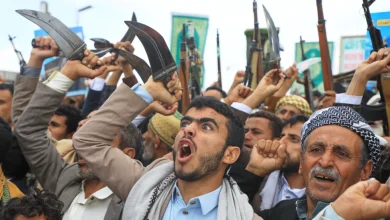
A man holds a poster outside the court in Dhaka on Nov. 17 calling for the death penalty ahead of the verdict against ousted Prime Minister Sheikh Hasina on charges of crimes against humanity for a deadly crackdown on student-led protests in 2024. | REUTERS
Human Rights Watch says the tribunal ‘failed to meet international fair trial standards’
A Bangladesh tribunal’s death sentence against former Prime Minister Sheikh Hasina marks an unprecedented moment in the country’s political evolution. Never before has a former head of government been convicted of crimes against humanity — and never under circumstances as deeply polarizing as these.
The verdict, reached by a special International Crimes Tribunal of Bangladesh, comes more than a year after the dramatic student-led uprising that ended Hasina’s 15-year rule, forced her into exile and ushered in an unelected interim administration led by Nobel laureate Muhammad Yunus.
Instead of restoring stability, the court’s decision appears likely to aggravate political tensions, embolden extremist elements and push Bangladesh further into an uncertain and volatile phase.
The three defendants — former Prime Minister Sheikh Hasina, former Home Minister Asaduzzaman Khan Kamal and former Inspector General of Police Chowdhury Abdullah Al-Mamun — were accused of inciting widespread attacks on protesters by security forces and Awami League supporters, authorizing the use of drones, helicopters and lethal weapons against unarmed demonstrators and failing to prevent or punish security-force atrocities, including three cases of illegal killings.
Hasina’s sentence, framed as a pursuit of justice, is widely perceived — both within Bangladesh and internationally — as an extension of longstanding political vendettas.
The tribunal, originally revived by Hasina in 2010 to try Jamaat-e-Islami leaders for atrocities committed during the 1971 Liberation War, is today being deployed to prosecute Hasina herself. This striking reversal has raised serious questions about political motivations.
For more than a decade, the Jamaat leadership faced marginalization, deregistration and sustained legal pressure under successive Awami League governments. Yet after Hasina’s ouster, Jamaat has reemerged from the political shadows and, according to multiple reports, has found common cause with the interim Yunus administration.
This convergence of interests between actors who were once determined adversaries has reinforced the belief among Hasina’s supporters that the trial represents political retribution. The same tribunal that once delivered death sentences to Jamaat leaders now stands accused of being weaponized to dismantle the Awami League’s influence and eliminate its central figure.
The rivalry between Muhammad Yunus and Sheikh Hasina is an inseparable part of this story. Their relationship has been defined for years by unresolved tensions, competing visions and personal mistrust.
When Yunus briefly signaled interest in entering politics in 2007, Hasina interpreted the move as a direct challenge. Investigations into microfinance institutions and administrative decisions against him during her tenure deepened the antagonism.
Yunus eventually relocated abroad, only to return triumphantly after Hasina fled to India in August 2024. The interim government that coalesced around him quickly banned the Awami League, initiated sweeping arrests of its senior leaders and revived multiple cases against Hasina. In this environment, the tribunal’s actions cannot be seen in isolation from the political context.
The decision to prosecute Hasina for crimes against humanity, especially when brought forward under a government led by her chief political rival, has inevitably invited accusations of bias.
Procedurally, the trial has been contentious. Hasina and her former home minister, Asaduzzaman Khan Kamal, were both tried in absentia, a practice permitted under Bangladeshi law but criticized by rights groups when applied in politically sensitive cases. Human Rights Watch, among other observers, determined the tribunal “failed to meet international fair trial standards.”
The evidence presented by the prosecution relies heavily on the testimony of the former inspector general of police Chowdhury, who turned state witness after being charged himself. Whether his testimony was given freely or under pressure has been widely debated.
Some of the most serious allegations, including claims that the government used helicopters and drones to attack student protesters, lack independently verified evidence and appear to be based primarily on testimonies of politically exposed individuals.
Critics argue that the prosecution failed to meet the evidentiary standards expected in a case of such gravity. The live telecast of the verdict, while framed as an attempt at transparency, has been interpreted as political spectacle designed to shape public sentiment rather than reinforce trust in the justice process.
The verdict has not brought calm. Instead, violence has intensified across Bangladesh. The Awami League’s call for a nationwide shutdown has paralyzed cities and transport networks.
A series of crude bomb explosions, arson attacks and clashes have been reported. Groups aligned with the Bangladesh Nationalist Party and various Islamist outfits have taken to the streets, some openly celebrating the verdict and others threatening further violence if Hasina attempts to return.
In recent months, the country has witnessed attempts to attack or vandalize symbols associated with the Awami League, including the iconic Bangabandhu residence in Dhanmondi.
Minority communities, particularly Hindus, have faced targeted assaults since the fall of the Awami League government, reflecting a rise in majoritarian and extremist mobilization. The interim administration has deployed paramilitary forces, border guards and the army, but the unrest continues to grow.
The political landscape has become more unstable because the interim government has banned the Awami League from political activity. This decision has disenfranchised millions of citizens. The Awami League is one of the largest mass-based political organizations in South Asia and any election held without its participation risks being seen as illegitimate.
The Yunus government’s insistence that elections will be held in February 2026 alongside a referendum on sweeping constitutional reforms has raised further suspicion. Critics argue that the political process is being engineered to prolong the interim administration’s hold on power under the pretext of institutional reform.
Holding a referendum and a general election on the same day appears to dilute voter focus and complicate democratic accountability at a time when the political environment is already deeply fractured.
The broader implications of the verdict and the shifting political dynamics extend beyond Bangladesh’s borders. The interim government’s rapid realignment in foreign policy marks a sharp departure from Hasina’s decade-long emphasis on stable relations with India. Engagements with China have accelerated, including discussions to acquire advanced military platforms such as J-10C fighter jets.
Reports of renewed warmth with Pakistan have further complicated the strategic picture. These moves have generated unease in New Delhi at a time when India’s security concerns in its eastern neighborhood are already heightened.
Hasina’s assertion in a recent interview that India remains Bangladesh’s most important relationship stands in stark contrast to the direction in which the Yunus administration appears to be steering the country.
The tribunal verdict, combined with allegations from Bangladeshi political actors that India is sheltering Hasina, has added a layer of diplomatic strain that risks long-term consequences for regional stability.
Against this rapidly deteriorating backdrop, the death sentence delivered by the tribunal appears less like a moment of justice and more like an accelerant poured onto an already volatile political landscape.
The verdict may inflame passions among Hasina’s supporters, encourage retaliatory mobilization and strengthen extremist groups seeking to exploit the power vacuum.
Rather than closing a dark chapter, it risks opening a more dangerous one by deepening societal divisions and inviting further unrest. A process that was meant to uphold justice has instead been interpreted as a political maneuver intended to eliminate a powerful rival and reshape Bangladesh’s political order.
The future remains uncertain. Much will depend on how the interim government manages the escalating tensions, how the Awami League responds to the pressure to remain politically dormant and how the international community positions itself.
What is clear, however, is that the tribunal’s verdict has not resolved Bangladesh’s crisis. It has intensified it. With political rivalries weaponized through legal channels, with mass mobilization rising on both sides and with regional tensions increasing, the path ahead is fraught with danger.
Hasina’s sentence may have been delivered, but the larger verdict on Bangladesh’s democratic future is still unfolding — and it threatens to destabilize the country more than ever before.